










































Confidence and Receptivity for COVID-19 Vaccines: A Rapid Systematic Review
Duke University (Lin, Tu); Florida State University College of Medicine (Beitsch)
"A comprehensive understanding of the current vaccine sentiment and potential determinants of people's behavior is critical for planning effective health communications to encourage uptake and successfully implementing population immunization."
In the early days of COVID-19 vaccine introduction, the public's confidence in and acceptance of these vaccines are unclear and changing, rendering achieving herd immunity challenging. This review compares trends and synthesises findings in vaccination receptivity over time across national (United States - US) and international polls, assessing survey design influences and evaluating context to inform policies and practices.
Data sources included academic literature and news and official reports surveying people's willingness to get a COVID-19 vaccine; 126 studies and surveys published between January 1 and October 20 2020 were selected. Table A4 in Appendix A in the paper summarises each survey's dates, country (if non-US), sample size, question wording, answer options, responses, key findings, and relevant factors.
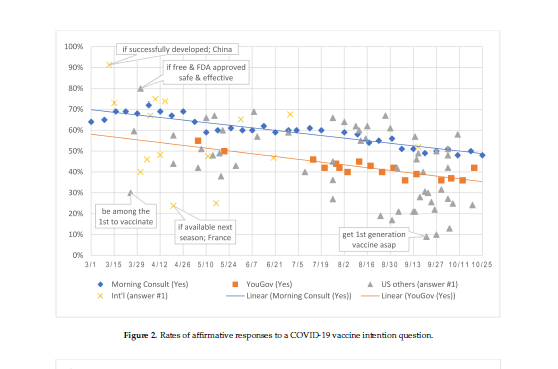
The review found substantial variations in COVID-19 vaccine receptivity between countries, states within the US, and subgroups. Among US surveys, the highest intended acceptance of 72% was reported by in early April 2020; in mid-October, the propensity dropped to its lowest at 48% (men 55%, women 42%). Some Asian countries had higher acceptance: 88.6-91.3% in China and 79.8% in South Korea, both of which also reported higher trust in central governments. Other highly receptive countries included Brazil (85.36%), South Africa (81.58%), Denmark (80%), and the United Kingdom (79%); Russia had the lowest (54.9%), followed by France (58.9-62%), which also reported the largest rate of "unsure" responses (28%).
The most commonly cited reasons for hesitation or refusal were fear of side effects, safety, and effectiveness. Belief that vaccines are unnecessary, inadequate information, unknown/short duration of immunity, and a general anti-vaccine stance were also associated with lower acceptance. A top facilitator of confidence is doctor recommendation, motivating 80% of Chinese and 62% of Americans. Opinion of families and friends also played a role, as did past inoculation history.
Several factors are unique to this pandemic due to the novelties and magnitude of COVID-19 and the highly polarised partisan environment - particularly in the US, where the expedited vaccine development caused apprehension and distrust. For example, 75% of Americans in one survey worried about the safety of fast-tracking. Hesitancy was manifested in the preference to wait: In the US, 60% were unlikely to get the first generation of vaccine, and 64% endorsed prioritising full testing even if doing so delayed availability.
Three studies analysed the prevalence and impact of conspiracy theories; respondents with higher skepticism had lower perceived risk and trust in government or professionals and, thus, higher doubts and objections to vaccination. Partisan influences were evident, with persistent vaccine attitude gaps between Democrats and Republicans in the US (80% vs. 48% acceptance, respectively). Conversely, in France, the Far Right parties had higher willingness to vaccinate. Declining trust of information sources and authorities was also observed in the US. On a related matter, one study found that those who indicated refusal for themselves also would not vaccinate their children.
In short, the review found that COVID-19 vaccine hesitancy is universal across countries, states, and subgroups (including healthcare providers and parents), as are its determinants. The researchers suggest that, to achieve herd immunity, communication campaigns are immediately needed, focusing on transparency and restoring trust in health authorities. Considerations include:
- The vulnerability of minorities, lower-income, and less-educated individuals to COVID-19 - and their considerably lower vaccine acceptance (e.g., one study found Blacks in the US were 40% more likely than Whites to reject the vaccine due to lack of trust) - requires special attention, including acknowledging the source and addressing the effect of their chronic distrust of health authorities.
- In general, men are more receptive to COVID-19 vaccines; women are more likely to worry about catching coronavirus, to be concerned about vaccine side effects, and to take protective measures (e.g., masking, handwashing, and social distancing). Such prevention-orientation variance calls for tailored communications and appeals.
- Campaigns seeking to reach those who responded "likely", "probably", or "not sure" regarding vaccine intention may be more fruitful than trying to convert those who stated "no" or "definitely not".
- In the US context (as elsewhere), emphasising transparency and adherence to scientific, high, and/or equitable standards throughout the vaccine development, approval, manufacturing, transportion, access, and distribution processes could help restore confidence.
- Messages should focus on the safety and efficacy of vaccines and clarify the value and necessity of immunisation in people's belief system (e.g., stressing that many vaccines have helped eradiate or control deadly diseases we are no longer aware of or concerned about because vaccines worked).
- Several studies underscored the likely resistance mandates may elicit, even among originally receptive groups; framing vaccination as a smart, purposeful personal decision and emphasising individual autonomy might be more effective.
- Communication strategies could use positive cues to action, including encouragement from loved ones and trusted figures such as physicians and religious leaders, the sharing of personal stories, and peer pressure. Studies have also shown social expectation and portraying anticipated regret from inaction to be potential motivators for vaccination.
- Mainstream news could counter misinformation, and using politically conservative outlets and doctors' communications are suggested for accurate messaging.
- In addition to traditional media and official websites for disseminating current and accurate information, social media can be a key channel in messaging and combatting anti-vaccine or conspiracy theories.
In conclusion: "The power of words and framing illustrated in this review helps shed light on strategic communication for motivating positive, collective pandemic response....Once vaccination starts, the likely decrease in new COVID-19 cases needs to be accurately highlighted as the outcome of vaccine uptake rather than being interpreted as lessened risk, something that could reduce the perceived need for vaccination."
Vaccines 2021, 9, 16. https://doi.org/10.3390/vaccines9010016
- Log in to post comments