










































Cleaner, Healthier, Happier
This Sesame Workshop initiative consists of a multi-media intervention to promote positive health behaviours in children ages three to seven years and their caregivers in Bangladesh, India, and Nigeria - with a focus on some of the economically poorest and most vulnerable communities. Launched in October 2012 and running until October 2015, the project provides messaging around sanitation and hygiene in areas such as latrine use, hand washing, and methods of storing and handling water. The campaign aims to reduce the number of children under the age of five who contract preventable and treatable diseases by providing access to meaningful sanitation and hygiene education.
Sesame Workshop is a non-profit organisation that partners with local writers, artists, researchers, and educators in 120 countries around the world to create entertaining yet educational (edutainment) programmes with characters, sets, and content specifically designed for young children. Cleaner, Healthier, Happier engages children by including in its activities and resources Sesame Street Muppets from each country's co-production of the original Sesame Street. [See Related Summaries, below.]
The project's multi-country approach blends mass media elements that are shared across countries with community-based interventions that are unique to each country. Specifically, the project features:
- Mass media: A series of four public service announcements (PSAs), broadcast nationally, focus on sanitation and hygiene and are distributed in each country's official language.
- Community-based interventions: In Bangladesh and India, this takes the form of community viewings of themed video content on sanitation and hygiene with accompanying print materials (e.g., books, floor mat games, posters, flip charts, comic books, and brochures) and mediation by a trained facilitator. In Nigeria, the core of the programme is formed by a school-based intervention with a series of comic books, theatre activities, and a DVD consisting of locally produced studio and live-action segments that reinforce the messaging in the PSA.
- A research-driven approach: In-country advisers inform the project's educational framework. There is also a needs assessment, formative testing of materials created for the project, a pilot evaluation of impact, and a survey of the project's reach.
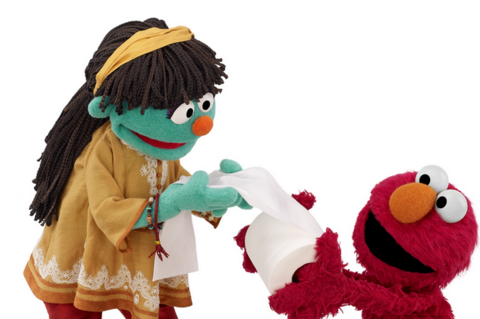
- A new Muppet: Noting that sanitation and water access disproportionately affect girls and women, and it is especially important for girls to have a unique voice in these issues, Sesame Workshop created the Muppet Raya. This 6-year-old aqua-green Muppet "loves to learn and remembers every fact she reads or hears....Always neat and clean, Raya pays close attention to her hygiene, but can be forgetful in other areas. While she may at times misplace her toys and books, she always remembers to wear her sandals to the latrine and knows how to avoid spreading germs". Raya was unveiled as part of the "Reinvent the Toilet Fair: India", a forum aimed to stimulate discussion and spur partnerships to bring affordable sanitation solutions to people who need it most. The fair was also intended to be "an opportunity to recognize India’s leadership and commitment to improving child health and fostering innovative solutions to persistent development challenges."
To cite one example of an in-person Cleaner, Healthier, Happier experience, in November 2014, Sesame Workshop India (SWI) launched an 11-week pilot campaign in Kolkata. Elmo, a Muppet from Galli Galli Sim Sim [see Related Summaries, below] was been joined by Raya. Workshops were held in which children learned from Elmo and Raya that germs are present everywhere, and wearing slippers to the toilet is important in staying healthy and germ free. In one "change story" provided by Sesame Workshop, we learn that, when Zarin Arshad watched the "tippy tap" segment during one of the Mobile Community Viewing (MCV) sessions, "he was inspired to build his very own tippy tap. He used an empty plastic bottle and some old rope to build the tippy tap and hung it outside his community toilet. He innovated the design further by tying soap to the tippy tap. He says that now, no one in his family forgets to use soap to wash their hands after using the toilet."
Children, Health
Citing United Nations Children's Fund (UN) data provided in 2012, Sesame Workshop notes that children - in particular, girls - are "adversely affected by lack of access to clean water and sanitation. Over 2 million children child deaths each year are attributable to poor hygiene and lack of safe water and basic sanitation....In many developing countries, schools lack proper latrines contributing to lower enrollment and higher drop-out rates for girls following puberty. Improving access to basic sanitation and clean water is a public health challenge in critical need of attention, as is fostering knowledge and behaviors around sanitation and health."
As of June 2015, Sesame Workshop had launched pilot projects and evaluations in Bangladesh, India, and Nigeria. Full-scale rollout has been completed in Bangladesh and will begin in Nigeria and India in June 2015. "Raya has gained traction as an ambassador for global health, participating in key events such as the launch of a UN initiative to end open defecation and the Global Citizen Festival in New York's Central Park, and a meeting at the World Bank highlighting children as agents of change in health."
Funded by the Bill & Melinda Gates Foundation.
Documents sent via email from June Lee to The Communication Initiative on June 5 2015; Sesame Workshop press release, March 19 2014 - accessed on June 12 2015; and email from June Lee to The Communication Initiative on June 30 2015. "Sesame Street" excerpts provided courtesy of Sesame Workshop (New York, New York) © 2015 Sesame Workshop. "Sesame Street" ® and associated characters, trademarks, and design elements are owned and licensed by Sesame Workshop. All Rights Reserved. Photo credit: John Barrett
- Log in to post comments