










































The CHAMPION Project
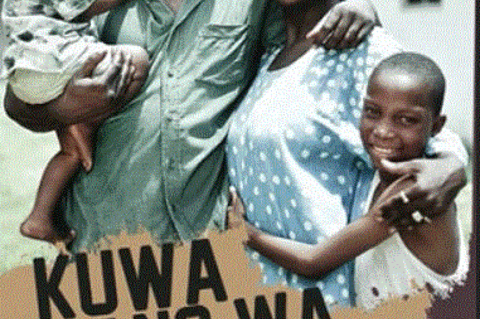
The CHAMPION Project is a five-year initiative launched in 2008 by EngenderHealth to increase men's involvement in preventing the spread of HIV in Tanzania. The project takes a holistic approach to HIV prevention and works to address the underlying gender issues that drive HIV transmission, as well as empower Tanzanian men to talk about their lives, to share their stories, and to reflect on their roles as men and the gender norms in their society. The project encourages men to Be a Role Model, through mass media, videos, and photo stories. EngenderHealth is working with FHI360 and diverse local partners, such as the Tanzania Commission for AIDS, the National Muslim Council of Tanzania, and the United States Agency for International Development (USAID).
According to EngenderHealth, because of power imbalances in sexual relationships, women are particularly vulnerable to HIV infection: more than half of the 1.4 million people living with HIV in Tanzania are women. The CHAMPION Project seeks to promote a national dialogue about men's roles and increase gender equity in order to reduce the vulnerability of men, women, and children to gender-based violence (GBV), HIV, and other adverse reproductive health (RH) outcomes. The project is working to reduce men's high-risk behaviours, promote fidelity and a reduction in the number of sexual partners, eliminate gender-based violence, and increase men's participation in health services. It does this by encouraging men to be actively involved in caring for their own health, and for the health of their families and communities and urges them to talk about their lives, to share their stories, and to reflect on their roles as men and the gender norms in their society. Project activities have included the following:
Mass Media:
As part of its work, the project implemented a mass media and community-based communications campaign to reduce societal acceptance of GBV in Tanzania. The campaign used national TV and radio over six months to cost effectively balance impact, reach, and frequency. Each TV spot was tactically bought to ensure maximum reach among men aged 25+. Spots aired on the two most watched stations during prime time news reached over 4.5 million men. In Tanzania, radio has substantial reach. Thus, the largest portion of the media budget was spent on radio with the national buy focused on the top three stations with the highest listenership. In addition, regional radio was bought in Iringa to support community level campaign efforts.
The CHAMPION Photo/Story Project:
In 2008, CHAMPION set out to find role models, or champions, within communities who could positively demonstrate that men’s involvement in achieving better health was not only possible but desirable. They hosted focus groups, conducted district assessments, and engaged community leaders, asking the common question: "Which man in your community stands out because of his efforts to promote the health of his family or community?" At specially arranged community meetings, the men identified made a presentation about their lives, their motivations, and their efforts to promote better health. And after hearing their testimonies, each community chose one of the men as their local champion. The Project introduced these local champions to a national audience, and they are also included in a booklet, Channeling Men's Positive Involvement in the National HIV Response [PDF]. According to EngenderHealth, as influential speakers, the Champions have helped the project reach nearly 120,000 with curriculum-based education, community engagement, workplace programming, and advocacy.
Community Activities:
Posters, brochures, flyers, t-shirts, buntings, coasters, and banners were produced for use in community activities in two of CHAMPION's key districts in Iringa Region, i.e., Mufindi and Iringa Urban. CHAMPION implemented interpersonal campaign activities, providing an opportunity for questions and feedback. Through small group and individual discussions, CHAMPION's local activists used campaign messages and materials to engage with over 6,900 men throughout 2012. Football matches, bar outreach, and road shows were implemented in CHAMPION's two key districts. During the football tournaments, players, coaches, and officials were given an orientation to the campaign and its key messages. Half times showcased edutainment events, and CHAMPION's local activists engaged with fans at each match. After football matches, the edutainment shows moved to local bars. A total of 33 bars were visited and branded with campaign messages. Event numbers estimated that close to 40,000 men and boys attended road shows, matches, and bar activities.
Gender Rights and Violence, HIV/AIDS
According to EngenderHealth, during the last few decades, gender-based violence (GBV) has gained international recognition as a grave social and human rights concern. In Tanzania, GBV is widespread. Despite this high prevalence of violence, formal support services for survivors are inadequate. Although there is a growing awareness of GBV and increased efforts at a policy level to address the issue, survivors' access to health, psychosocial, and legal services remains limited. The 2010 Tanzania Demographic Health Survey (TDHS) showed that GBV is widespread throughout Tanzania and is predominantly intimate partner violence (IPV). 44% of ever-married women reported experiencing physical or sexual violence by their current/most recent husband or partner. 83.4% of women aged 15-49 who ever experienced physical violence reported their violators were a former or current boyfriend, husband, or partner. 54% of women and 38% of men aged 15-49 believed that a husband is justified in beating his wife for certain reasons such as burning the food or refusing to have sex.
EngenderHealth was awarded the 2nd Avon Communications Awards: Speaking Out About Violence Against Women for their work to bring attention to the need to end violence against women.
EngenderHealth, FHI360, Tanzania Commission for AIDS, United States Agency for International Development, the National Muslim Council of Tanzania.
EngenderHealth website, EngenderHealth website, Champion Campiagn fact Sheet [PDF] on July 7 2013 2013.
- Log in to post comments