










































Awareness of Cervical Cancer and Willingness to Be Vaccinated against Human Papillomavirus in Mozambican Adolescent Girls
Universitat de Barcelona (Bardají, Casellas, Menéndez); Consorcio de Investigación Biomédica en Red de Epidemiología y Salud Pública, or CIBERESP (Bardají, Menéndez); Centro de Investigação em Saúde de Manhiça, or CISM (Bardají, Mindu, Augusto, Cambaco, Macete, Menéndez, Sevene, Munguambe); Aga Khan Foundation (Simbine); Mozambique Ministry of Health (Matsinhe); Universidade Eduardo Mondlane (Sevene, Munguambe)
This study evaluates the feasibility of human papillomavirus (HPV) vaccination among adolescent girls in Mozambique - to assess the beliefs, awareness, attitudes, and behaviours of the populations and providers involved - in order to support the success and sustainability of HPV vaccine introduction before moving towards national-scale implementation.
As reported here, cervical cancer incidence rates in Mozambique are worrisome. This is largely due to the fact that in Sub-Saharan Africa (SSA), the prevalence of HPV infection is the highest in the world, that cervical cancer screening programmes are rare or operate with limitations, and that high-quality treatment is either unavailable or unaffordable. The highly prevalent co-infection with human immunodeficiency virus (HIV) in these settings also increases the risk of HPV infection and progression to cancer.
Thus, in 2013, Mozambique was granted Global Alliance for Vaccination and Immunization (GAVI) support for a 2-year demonstration programme, meant to reach adolescent girls (aged 10-19 years old), in preparation for a national scale-up of vaccination against HPV. The demonstration programme included an awareness campaign that consisted in community radio spots broadcast in advance of the vaccinations, question-and-answer booklets distributed in the communities, and posters posted at health facilities and schools. While posters and radio spots focused on the vaccine and its relevance to a healthy present and future life, the question-and-answer booklet focused on the female reproductive tract, characteristics of cervical cancer, modes of transmission, and prevention.
A cross-sectional study was conducted between August 2013 and May 2014, prior to the first round of the HPV vaccine demonstration programme. Face-to-face structured interviews were conducted among 1,147 adolescents in 3 selected geographically different districts of the country. Two of the 3 districts where this study was conducted (Mocímboa da Praia and Manhiça) were target districts for the demonstration programme.
Most girls [84% (967/1,147)] had heard of cervical cancer, while 76% believed that cervical cancer could be prevented. However only 33% (373/1,144) of girls had ever heard of HPV. When asked about which tools or strategies could prevent cervical cancer, 64% (551/855) reported vaccination, though only 36% (407/1,133) had ever heard of a specific vaccine to prevent it. When girls were asked whether they would accept to be vaccinated if a vaccine was available in Mozambique, 91% (1,025/1,130) answered positively.
Main determinants of acceptability and willingness to be vaccinated against HPV were the level of education, together with previous knowledge about cervical cancer and available tools to prevent it. Girls from the HPV demonstration districts showed higher awareness on HPV and cervical cancer and higher willingness to be vaccinated. This reflects the effect of already ongoing circulating information (provided as part of education and communication activities described above) prior to vaccination campaign in pilot areas. Indeed, in these 2 districts, the main source of information for HPV and cervical cancer reported by study participants were the information activities preceding the HPV vaccination campaign.
"While willingness to be vaccinated to prevent cervical cancer was high, participants showed little understanding about best timing to be vaccinated and the link between the efficacy of the vaccine and sexual debut. The low awareness of HPV infection reported together with the high willingness to be vaccinated seemed paradoxical, but this might be explained by the adolescents' understanding and perception that the purpose of vaccination was to prevent cervical cancer rather than to avoid a sexually transmitted infection."
In conclusion, "[t]his study anticipates high acceptability of the HPV vaccine in Mozambique and high awareness about cervical cancer, despite low HPV knowledge. These results highlight that targeted health education programmes are critical for acceptance of new tools, and are encouraging for the reduction of cervical cancer related mortality and morbidity in Mozambique."
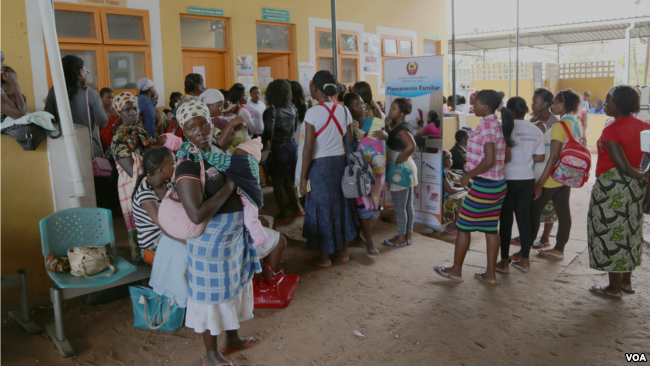
Papillomavirus Research, Volume 5, June 2018, Pages 156-162. https://doi.org/10.1016/j.pvr.2018.04.004. Image caption/credit: "Women wait outside the family clinic, Boane, Mozambique, Nov. 20, 2014." (Gillian Parker/VOA)
- Log in to post comments