










































Addressing Stigma and Gender-Based Violence to Improve HIV Service Delivery to Key Populations: Findings From a Rapid Assessment
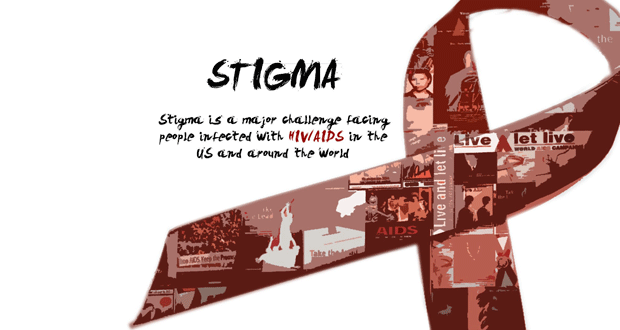
"In Guyana, there is concern that KPs [key populations] are not being adequately reached with [HIV prevention and treatment] services and that insufficient frameworks, policies, and regulations are contributing to the marginalization of those at greater risk of HIV infection."
From Advancing Partners & Communities (APC) Project, implemented by JSI Research Training Institute in partnership with FHI360 and The International Center for Research on Women (ICRW), this rapid assessment was conducted in Guyana to gather information on the programmatic and capacity needs of the non-governmental organisations (NGOs) supported through APC "to implement services for key populations as well as the structural challenges faced by these NGOs." Interviews and focus group discussions (FGDs) with staff from fifteen NGOs and nine key stakeholders from the Government of Guyana (GOG) and development agencies were conducted in 2014 to find new structural and programmatic directions and capacity strengthening needs to inform the development of a training course and ongoing technical assistance for capacity building to integrate stigma and discrimination (S&D) and GBV prevention and response activities and expand services of local organisations. The 90-minute interviews were transcribed and analysed for key themes and findings
Because adult prevalence of HIV in Guyana in 2014 was low (1.4%) but as high as 19.4% among men who have sex with men (MSM) and 16.6% among female sex workers (FSWs), KPs, including as well transgender (TG) individuals, sex workers (SWs), and women, were the focus of concern in trying to reach KPs with services. S&D includes shaming, despite programmatic efforts at stigma reduction due to high staff turnover, particularly among police and health care workers. Homophobia and the illegal status of same-sex sexual behaviour reduce willingness to engage with police over intimate partner violence. SWs are less willing to seek prevention, care, and treatment services or police help due to S&D, and Transgender (TG) individuals can face extreme violence.
The Ministry of Health requires posting of a non-discrimination policy at health centres and now requires that anonymous suggestion boxes be placed in health facility waiting areas so clients can report bad experiences or abuse. A disincentive is the placement near reception desks. Work in secondary schools on stigma through sessions on HIV, sexuality, and violence in the classroom setting or through after-school sports-based programmes has revealed that students prefer to talk with social workers, not teachers, in the sessions. Workplace training has yielded mixed results and limited employment of people living with HIV (PLHIV). Women who suffer GBV are hesitant to leave their husbands, often for reasons of economic dependence.
Structural direction recommendations include:
- Rigorous training in professional schools - doctors, nurses, social workers, police, and teachers - on S&D pertaining to HIV and KPs. Trainings on harmful gender norms that perpetuate GBV should be integrated into the curriculum of professional training programmes.
- Training of police officers for appropriate and effective GBV response and violence prevention, including ending police abuse.
- Expanding shelter and economic empowerment opportunities for survivors of violence so that they can exit abuse relationships.
New programmatic directions include:
- Shift norms among the general population through, for example: "support in developing media campaigns and edutainment initiatives to foster community and national dialogue and change" and work "specifically with men for violence prevention, stigma reduction, and the promotion of healthy masculinities."
- "Expand educational sessions with youth in schools...to promote sexual health and reduce harmful gender norms and stigmatizing attitudes."
- "Expand and enrich support groups for KPs..." through support group sessions to help clients overcome internalised stigma and engage in health-protective behaviour.
- "Empower survivors of violence to facilitate exiting a relationship."
Capacity-strengthening needs of NGOs include:
- "Training in basics of GBV (including IPV, non-partner sexual assault, and hate-based violence and harassment)
- A GBV screening tool and training on how to use it
- Refresher training on stigma, with a focus on KPs
- Support to monitor and evaluate their efforts to reduce stigma and GBV
- Support to expand and develop new edutainment strategies to reach the general population"
The APC website, February 1 2018. Image credit: The Guyana Chronicle
Comments

Fully endorsed
I totally agree with this post. Stigma and discrimination is a prevalent theme in HIV/AIDS especially in Jamaica. Therefore new programmatic directions and Structural direction recommendations are indeed necessary.
Great Initiative
It is a great initiative when groups from different nations can come together to development ways to address a common issue. #SBCCsummit2018
7 Important things we can do to reduce Stigma and Discrimination
1. Know the facts.
2. Be aware of your attitudes and behaviour
3. Choose your words carefully
4. Educate others
5. Focus on the positive
6. Support people
7. Include everyone
#SBBCSUMMIT2018
A Great Initiative
The quicker we admit to a problem then the quicker we can create a solution, I am happy that a structural direction was created and coming from that a new approach created. In order to reach the key population, one has to understand why they are going underground, one of the biggest cause in this region is stigma and discrimination from the people who are in the institutions that are to help. The only way this will change is through proper training and also creating new ways of reaching those who form part of the key population, the support group is critical, the public education is needed because we have to shift the social thinking and change the stigma that permeates the society. Socialisation on many fronts cause individuals to think a certain way and to react a certain way but through support groups (which will give power to those in the situation) along with public education campaign while training those who must deal with the key population we will have change. The change will not come immediately, it takes time but what is important is that there is continuous research and with the implementation, one has to test to see what works and make adjustments so that it can become better. #SBCCsummit2018

Let us come together #SBCCsummit2018
Stigma and discrimination related to HIV and AIDS are almost as old as the pandemic itself, and, regrettably, often exist in health care settings. Discrimination against people living with HIV or AIDS results in poor quality of care for those who are infected or ill (or suspected of being infected), frightens away potential clients in need of care, and undermines effective HIV prevention efforts by limiting individuals' access to and use of health care services. As HIV treatment programs become increasingly available in resource-poor countries, access to and use of these lifesaving services will depend on the degree to which health facilities welcome and respect the rights of HIV-positive clients.
#SBCCSUMMIT2018
Social Behaviour Change Communication can help persons who feel victimised or vulnerable to feel informed and empowered to take control over their lives. Looking forward to the #SBCCSUMMIT2018 Discussions!
- Log in to post comments